Operating Model Assessment
Astrenox will map responsibilities across product teams, engineers, technical leaders, and AI agents to define clear ownership across the engineering lifecycle.
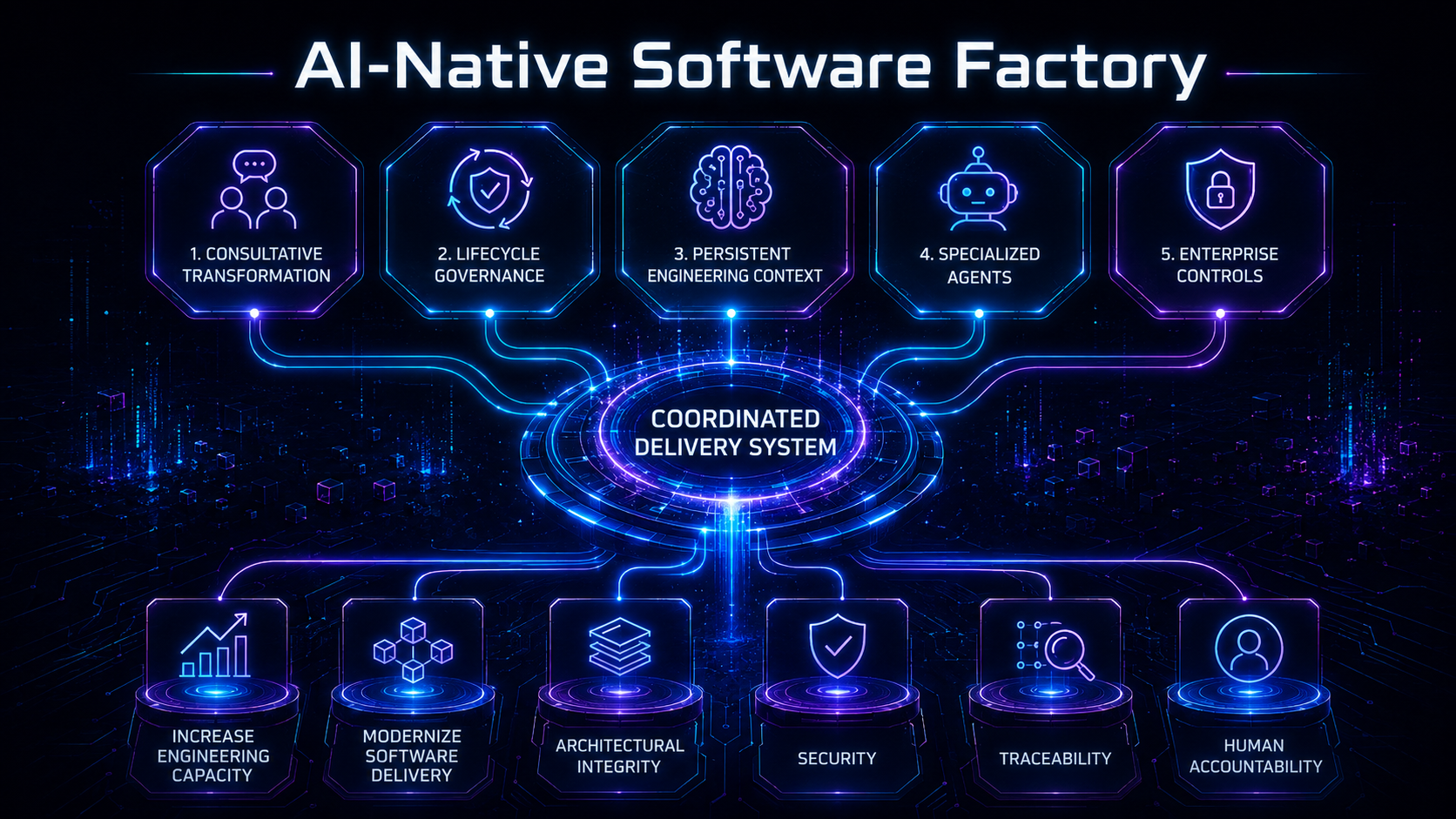
AI-Native Software Factory
Enterprise AI creates value when it improves the full engineering lifecycle, not just code generation. Astrenox combines AI-native development, specialized engineering agents, and human-governed controls across planning, build, testing, deployment, and operations to accelerate delivery while maintaining architectural, security, and production oversight.
Astrenox will map responsibilities across product teams, engineers, technical leaders, and AI agents to define clear ownership across the engineering lifecycle.
Astrenox will identify lifecycle stages across planning, development, testing, review, deployment, and operations that are suitable for AI-assisted or agentic automation.
Astrenox will define architecture standards, security controls, data-handling policies, and technical guardrails required for safe AI-native engineering.
Astrenox will establish human approval, review, exception, and escalation points for architecture decisions, sensitive changes, and production releases.
Astrenox will assess repositories, ticketing systems, CI/CD pipelines, observability platforms, and engineering tools required to integrate AI agents into existing workflows.
Astrenox will define measurable KPIs across delivery velocity, software quality, reliability, engineering productivity, and AI adoption.
Astrenox will begin with a focused pilot, validate governance, workflow reliability, and business outcomes, then expand the operating model across additional teams, repositories, and engineering workflows.
Astrenox will centralize feature requests, defects, security findings, modernization initiatives, operational alerts, and customer feedback through a common intake layer.
Astrenox will assess business priority, urgency, dependencies, technical impact, and delivery constraints to determine execution order.
Astrenox will identify architectural, system, data, security, and team dependencies before work enters execution.
Astrenox will route each request into the appropriate engineering workflow based on scope, risk, ownership, and approval requirements.
Astrenox will convert approved requirements into clearly defined functional scope, acceptance criteria, architectural constraints, security expectations, and release conditions.
Astrenox will transform structured requirements into machine-readable execution contracts so AI agents operate against defined objectives and controls rather than unstructured prompts.
Astrenox will connect requirements, architecture decisions, repositories, APIs, dependencies, documentation, tickets, and operational history into a shared context layer.
Astrenox will improve system understanding across large codebases by preserving relationships between services, components, APIs, dependencies, and prior engineering decisions.
Astrenox will capture and retain engineering context across teams and agent sessions, reducing repeated discovery and loss of technical knowledge.
Astrenox will enforce enterprise policies across model access, repository permissions, approved tools, secure coding standards, testing thresholds, and agent autonomy levels.
Astrenox will define validation, approval, and release controls that govern how AI-generated changes progress from development through production.
Astrenox will enable multiple AI agents to work concurrently across independent engineering tasks and lifecycle stages using the same organizational context, architecture standards, and governance policies.
Astrenox will automate recurring engineering work such as dependency upgrades, vulnerability remediation, test generation, documentation maintenance, and routine operational tasks.
Astrenox will route every change through testing, code review, security analysis, and policy validation before merge or release.
Astrenox will assess functional correctness, architectural alignment, maintainability, test coverage, contract changes, regression risk, and policy compliance through dedicated review workflows.
Astrenox will identify authentication issues, exposed secrets, unsafe data handling, vulnerable dependencies, insecure configurations, and deviations from approved threat models.
Astrenox will route high-risk findings to designated reviewers while allowing low-risk, well-defined workflows to progress with greater automation.
Astrenox will map legacy codebases, dependencies, undocumented business rules, and operational behavior before defining controlled modernization workstreams.
Astrenox will use AI agents to support framework upgrades, monolith decomposition, cloud and database migrations, API modernization, test-suite generation, and technical-debt reduction through incremental, reviewable work orders.
Astrenox will enable agents to analyze alerts, logs, traces, deployments, and repository history to support incident triage, root-cause analysis, remediation planning, patch generation, and runbook updates.
Astrenox will define autonomy levels based on workflow maturity and business risk, allowing low-risk tasks to execute automatically while sensitive changes require explicit human approval.
Astrenox will record business intent, approved requirements, agent actions, accessed systems, code changes, validation results, policy exceptions, approvals, and deployment outcomes across every workflow.
Astrenox will continuously compare proposed changes against approved requirements, architecture standards, security policies, and service contracts before release.
Astrenox Software Factory can operate across public cloud, hybrid cloud, private VPC, on-premises, customer-managed, and fully air-gapped environments while keeping model endpoints, agent runtimes, source code, and telemetry within the required security boundary.
The platform supports SSO, SAML, OIDC, automated user provisioning, and role-based access controls to manage user, team, agent, repository, and environment permissions.
Administrators can define who can launch agents, which repositories and environments they can access, which tools and models are permitted, and what actions require human approval.
Astrenox will allow autonomy levels to be configured by workflow, project, risk profile, and environment so low-risk tasks can progress automatically while sensitive actions remain governed.
Engineering leaders can centrally control approved models, routing policies, tool access, project-level usage, and execution boundaries across agent workflows.
The platform provides controls for workflow limits, model consumption, project-level usage, and spending thresholds to keep AI engineering costs measurable and predictable.
OpenTelemetry-compatible logs, metrics, and traces can integrate with existing observability and security platforms to monitor agent sessions, tool usage, code changes, validation results, failures, and deployments.
The platform can surface policy violations, unauthorized access attempts, failed validations, abnormal agent behavior, and other security-relevant events during execution.
Astrenox will maintain detailed records of agent activity, accessed systems, code changes, approvals, validation outcomes, policy exceptions, and deployment history for governance and review.
Security, software-assurance, and AI-governance controls can be configured according to the client's industry, deployment model, internal policies, and regulatory obligations.